Affiliate Disclosure: This site may contain affiliate links. When readers purchase through these links, we may earn a commission at no additional cost to them.
15 vs 20 Degree Knife Sharpening Angle: Which Is Better for Kitchen Knives?
For most home cooks, the real choice is not every possible sharpening angle. It is whether your knife should be sharpened around 15 degrees per side or 20 degrees per side. A 15 degree edge feels keener and slices more easily. A 20 degree edge gives up a little slicing feel for more durability.
If you only want a quick answer: use 15 degrees per side for thin Japanese-style kitchen knives and careful slicing work. Use 20 degrees per side for thicker Western chef's knives, utility knives, and knives that see harder board contact. If you are not sure what the knife had before, match the existing bevel before trying to reprofile it.
15 vs 20 Degrees: Quick Decision Table
| Question | Choose 15 degrees per side | Choose 20 degrees per side |
|---|---|---|
| Knife style | Thin Japanese gyuto, santoku, nakiri, petty | German-style chef's knife, thicker utility knife, older soft-steel kitchen knife |
| Main use | Vegetables, boneless protein, clean slicing | Mixed prep, harder board contact, rougher home use |
| Edge feel | Sharper-feeling and easier to start a cut | Slightly less keen but more forgiving |
| Learning cost | Less room for wobbly angles and heavy pressure | More forgiving while you learn |
| Common mistake | Going too thin on a knife that chips or rolls | Leaving a thin knife feeling duller than it needs to be |
Is 15 Degrees Good for a Home Cook?
Yes, 15 degrees per side can be good for a home cook if the knife is thin enough and you use it for normal kitchen slicing. It is not automatically better for every knife. A thin edge can roll, chip, or lose bite quickly if the steel is soft, the blade is thick behind the edge, or the knife is used for twisting, scraping, frozen food, bones, or hard squash.
A good practical rule is this: if the knife already feels delicate and slices well when sharp, 15 degrees is reasonable. If the knife feels thick, heavy, or lives in a busy family kitchen, 20 degrees is usually the safer starting point.
How to Judge the Current Knife Angle
Before changing angles, look at the existing bevel. A wide, visible bevel usually means the knife has already been sharpened at a lower angle. A tiny, durable bevel on a thicker German-style knife is often closer to 20 degrees per side. When in doubt, match the current bevel first instead of grinding away steel to chase a number.
The marker test is the easiest way to check. Color the edge bevel with a permanent marker, make a few light passes at your chosen angle, and inspect where the ink disappears. If the ink is removed above the edge but not at the apex, your angle is too low. If only the shoulder disappears and the edge still feels dull, raise the angle slightly.
What 15 Degrees Means
In most knife sharpening guides, 15 degrees means 15 degrees per side, not 15 degrees total. A knife sharpened at 15 degrees per side has an included edge angle of about 30 degrees. A 20 degree per side edge has an included angle of about 40 degrees.
That difference matters. The 15 degree edge is thinner at the very edge, so it can feel sharper with less pressure. The 20 degree edge leaves more metal behind the apex, so it usually survives rougher kitchen use better.
When to Use Each Angle
- Use 15 degrees for thin Japanese-style kitchen knives, light prep, careful slicing, and cooks who maintain their knives before they get truly dull.
- Use 20 degrees for Western chef's knives, shared household knives, cheaper soft-steel knives, or any blade that gets knocked around in daily use.
- Stay near the original angle if the knife was expensive, unfamiliar, already sharpened well, or has a very uneven bevel.
- Avoid very low angles on cleavers, outdoor knives, serrated knives, and anything used against bone, frozen food, or hard materials.
How to Actually Sharpen at 15 or 20 Degrees
On a freehand stone, start with light pressure and aim for consistency more than mathematical perfection. A rough visual guide is to lift the spine about the height of two stacked coins for a lower kitchen angle, then adjust with the marker test. Wider blades need more spine lift than narrow blades at the same angle, so do not rely on coin height alone.
With a guided sharpening system, set the angle before you start and keep the strokes light. Guided systems are especially useful if your main question is "15 or 20 degrees?" because they let you test a controlled edge instead of guessing whether your hand angle changed.
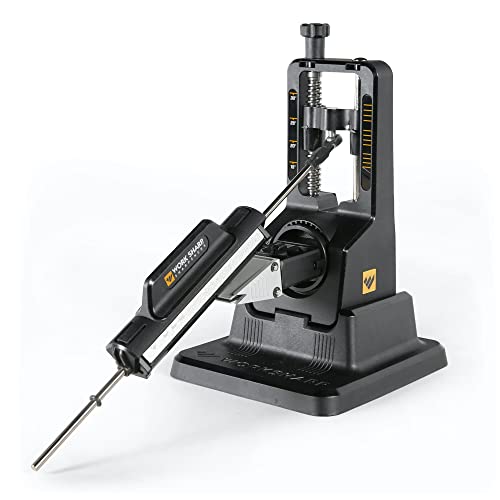
Work Sharp Precision Adjust Knife Sharpener
A clamp-and-rod guided system that gives beginners repeatable angles without learning freehand stone control first.
Angle-Control Tools Compared
| Tool type | Angle control | Best fit | Watch out for |
|---|---|---|---|
| Adjustable guided system | Usually the most flexible for 15 to 20 degree decisions | Beginners who want repeatable results across several knives | Clamp setup and blade shape can affect the real angle |
| Fixed-slot guided system | Simple preset angle positions | Budget users who want guidance without electronics | Less flexible if the knife needs an in-between angle |
| Rolling sharpener | Simple magnetic angle support, often aimed at kitchen knives | Home cooks who want a short learning curve | Less suited to very small blades, recurves, or unusual shapes |
| Whetstone with angle guide | Helpful reference, but your hand still controls consistency | Users who want the flexibility of stones | Angle guides can scratch blades or create a false sense of precision |

Lansky Deluxe 5-Stone Sharpening System
A classic clamp-based system with several stones and fixed angle slots for pocket knives and many kitchen knives.
Where Rolling Sharpeners Fit
Rolling sharpeners are popular because they turn the angle problem into a simple magnetic support setup. They can make sense for standard kitchen knives if you want a repeatable 15 or 20 degree style edge without learning freehand strokes. They are not the best answer for every blade shape, but they are a reasonable category to compare if your main goal is angle control.

Tumbler Rolling Knife Sharpener
A lower-cost rolling sharpener kit that pairs a rolling abrasive with magnetic angle support for beginner-friendly kitchen sharpening.
Common Mistakes
- Choosing 15 degrees because it sounds sharper: a thinner edge is only better if the knife and steel can support it.
- Changing the whole bevel too soon: match the existing edge first unless you have a clear reason to reprofile.
- Using heavy pressure on a low angle: this can round the edge or create a stubborn burr instead of a cleaner apex.
- Skipping burr removal: a wire edge can feel sharp briefly, then fold over and make the angle choice look worse than it is.
What to Do If It Feels Wrong
If the knife is not improving, stop and diagnose before doing more passes. If the edge still slides on tomato skin, you may not be reaching the apex. If the knife gets sharp but dulls after one or two meals, the angle may be too low for that knife or the burr may not be fully removed. If one side forms a burr and the other does not, work the weaker side until the burr is consistent, then switch to lighter alternating passes.
If the edge chips after moving to 15 degrees, do not keep polishing it. Raise the angle toward 18 to 20 degrees or add a tiny micro-bevel with a few very light passes at the higher angle. A micro-bevel is often a better fix than fully regrinding the whole knife.
When Not to Keep Sharpening
Stop once the edge cuts paper cleanly or bites into tomato skin with light pressure. Do not keep lowering the angle just because the knife could be sharper. Also stop if the bevel is getting much wider, the tip is changing shape, or you are removing metal without feeling a burr. Those are signs to reset your technique before continuing.
What to Buy and What to Skip
If angle control is the part that feels impossible, an angle guide, guided system, or rolling sharpener is more useful than another polishing stone. If you already hold a steady angle, buy a stable stone holder before buying extra grits. Skip ultra-low angle experiments on heavy Western kitchen knives until you understand how the edge holds up in your own cooking.
When to Use a Whetstone Anyway
A stone is still the most flexible option if you are willing to practice. Start with a 1000 grit stone, use a marker on the bevel, and focus on consistency before speed. For many beginners, a 1000 grit stone plus an inexpensive angle guide is enough to learn whether 15 or 20 degrees makes sense before buying a full sharpening system.

Sharp Pebble 1000/6000 Whetstone Kit
A popular beginner kit that bundles a 1000/6000 water stone, bamboo base, and angle guide.